Tile Product
Metadata
Data product name |
DpdMerTile |
Data product custodian |
MER |
Name of the Schema file |
|
Last Edited for DPDD Version |
2.0 |
Processing Element(s) creating/using the data product |
Creators:
Consumers:
|
Processing function using the data product |
MER, EXT, PHZ |
Proposed for inclusion in EAS/SAS |
This product is proposed for inclusion in the SAS: maybe. These products partition the sky in a semi-regular grid for MER processing. It could be useful for scientists to have access to this tiling. |
Data Product Elements
Header |
object of type sys:genericHeader |
Data |
object of type mer:merTile |
QualityFlags |
object of type dqc:sqfPlaceHolder |
Parameters |
object of type ppr:genericKeyValueParameters |
Detailed Description of the Data Product
This is an input product to the MER Pipeline. Tiles partition the sky in a semi-regular grid. The MER pipeline is run in each tile and their output products follow the tile spatial footprint.
MER tiles are defined by their central position (RA, Dec) and size (width, height), and identified by a unique tile identifier (Kümmel et al. 2022). Each tile has an extended area and a core area defined in HEALPix indices (Górski et al. 2005). While the extended areas of adjacent tiles have 2’ overlap to avoid border problems in the measurements, the core areas of any two tiles do not overlap.
In the current Euclid tiling solution (v1.2) the extended areas and the core areas of all tiles cover the entire sky in the range -88.0° < Dec < +88.0°. The tile placement is independent of the pattern of the Euclid observations and the Euclid Survey planning.
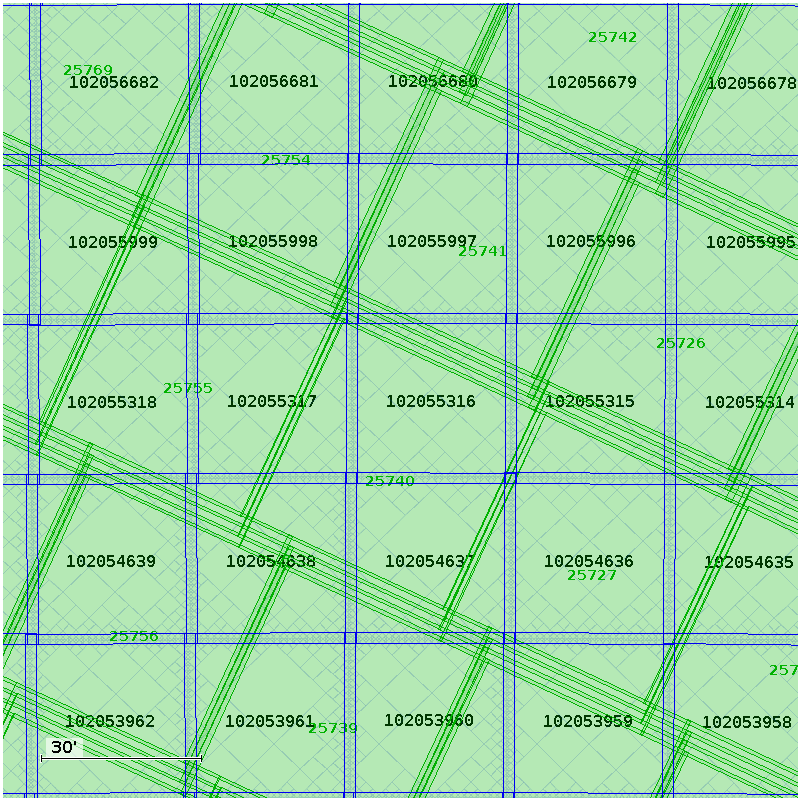
Fig. 51 An example Euclid sky area showing the expected Euclid pointing positions according to the Operational Sky Survey (green polygons) and the associated MER tiles extended areas (blue polygons). The Euclid observation ids, the tile indices and the tile core area MOC pixels are also shown.
WIDE tiles are used for the WIDE survey processing and typically have core area sizes ~ 30’ x 30’ and extended area sizes ~ 32’ x 32’. DEEP tiles are used to process the Euclid DEEP fields and their core areas are 4 times smaller (~ 15’ x 15’, extended area ~ 17’ x 17’). There are also some SPECIAL tiles that can be larger than the WIDE tiles and are defined to cover a predefined catalog of exented objects.
The imaging output of the MER pipeline covers the extended tile area. Object detection and property measurements are done on the extended tile area. The catalog output is delivered only for the core area, thus avoiding multiple outputs of the same object.
The main elements inside the MER tile product are:
TileUseCase: The use case for which the tile has been defined (e.g. WIDE, DEEP, CALIBRATION).
TileFlavour: The tile falvour (e.g. NORMAL, BORDER, SPECIAL)
TileIndex: The tile index.
Version: The tiling release version.
RaCen: The tile center Right Ascension coordinate.
DecCen: The tile center Declination coordinate.
Width: The tile width in pixels.
Height: The tile height in pixels.
OuterNUNIQIndex: The outer tile area MOC Healpix indices.
InnerNUNIQIndex: The inner tile area MOC Healpix indices.
OuterSpatialFootprint: The outer tile area spatial footprint. The outer area of a given tile overlaps with other tiles.
InnerSpatialFootprint: The inner tile area spatial footprint. The inner area of a given tile does not overlap with other tiles.
ExtendedObjects (optional): List of extended objects falling inside the tile area.