Introduction
The purpose of the OU-SHE PF is to take reduced VIS images, along with supplementary data and processed data from OUs MER, PHZ, SIM, EXT, and use them to generate calibrated, science-ready cosmological shear measurements for use in OU-LE3, and more generally as a core Euclid science product.
The cosmological shear signal is encoded as a distortion in the images of distant galaxies. This distortion, a tidal stretching, is of the order of one percent and must be measured to one part in a thousand by Euclid in order to reach the Requirements on Euclid Primary Science [MRD]. The shear distortion on an individual galaxy image is indistinguishable from the intrinsic galaxy shape and so galaxy images must be combined to estimate the shear. The distortion effects of a Euclid image are captured by the Euclid optical PSF. One of the main PE of SHE is an accurate model of the Euclid optical PSF which is used to correct the shear measurement.
Shear measurement algorithms can be split into model-fitting methods, which fit a sheared model to each galaxy image, and moment-measuring methods which compress the galaxy image into an effective ellipticity which is then used to estimate shear. Both methods can be formulated in both Frequentists and Bayesian frameworks, depending on what is assumed about the measured statistics and their propagation. As the ellipticity response to shear is nonlinear any estimation method will be intrinsically biased and so an algorithmic correction needs to be implemented.
The primary SHE Processing Elements are:
- PSF Correction
PSF fitting and calibration using stars.
PSF modelling of galaxies
- Shear Measurement
Model Fitting.
Meta Calibration with moment measuring.
- Shear Calibration
Euclid SGS simulations for calibration, and empirical additive calibration.
- Shear Validation
Empirical and simulation-based validation tests.
To correct the Euclid galaxy images for instrumental distortion, SHE needs to generate an accurate wavelength-, position-, exposure-, flux- and time-dependent optical PSF model. This will be used to correct images for distortions that contaminate the shear measurement. To carry this out, SHE has developed a detailed PSF analysis based upon a wavefront model of the distortions of the Euclid focal system.
Fitting to stars in PDC images to measure the amplitudes of Zernike coefficients in the wavefront error models and detector dependent effects is done in two steps of the PSF calibration pipeline. Firstly, sets of defocused images (INTRA and EXTRA) are used that reduce the detector dependent effects. The AOCS data corrects for the tiny guiding movements of the telescope, Gaia XP data is used for SED of bright defocussed stars.
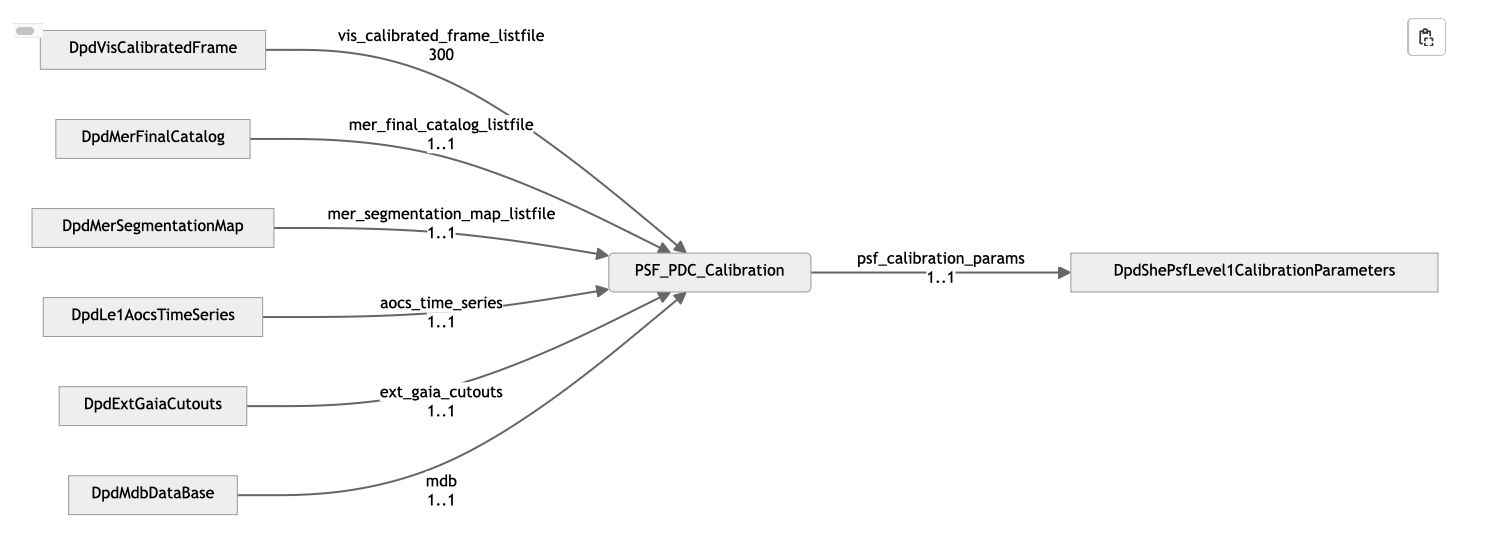
Secondly infocus images are used. Combining 2 defocuses and infocus data breaks the degeneracies on different Zernike polynomial amplitudes. Here PHZ data are used for SEDs of fainter stars, but Gaia photometric data is still used in star-selection. The wafefront solution in the calibration file from the defocussed stars is used to fix some of the Zernike modes for the infocus calibration.
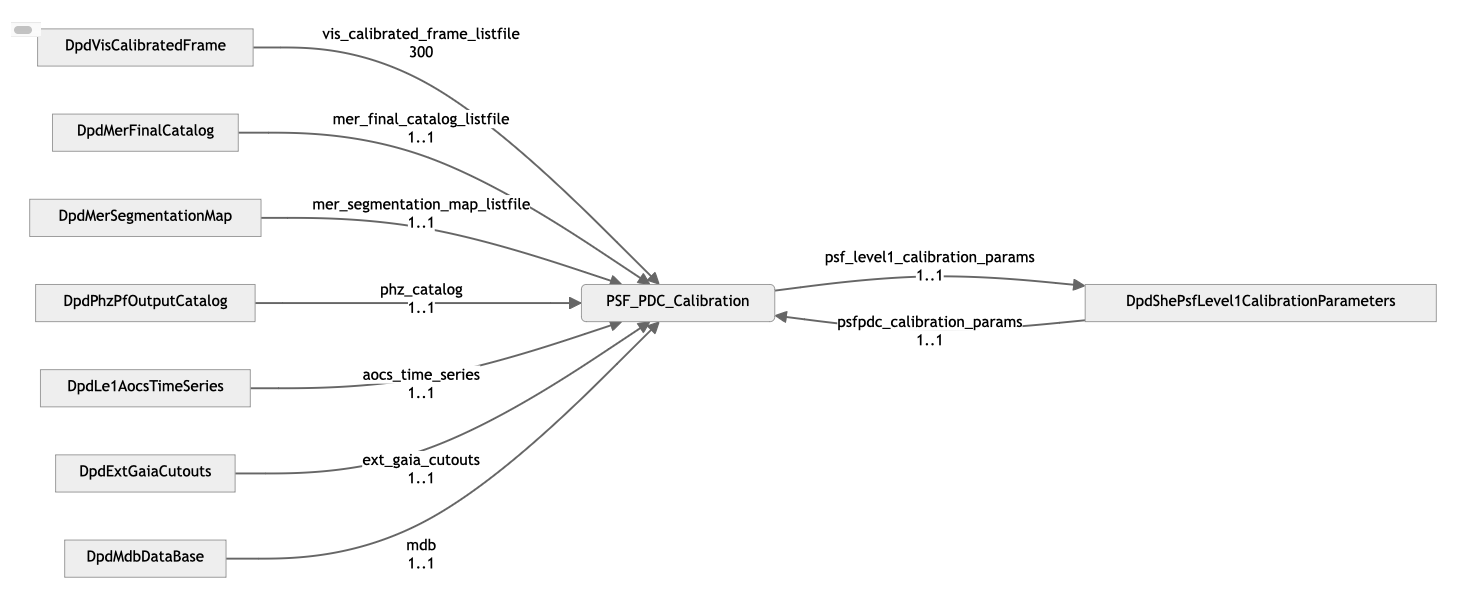
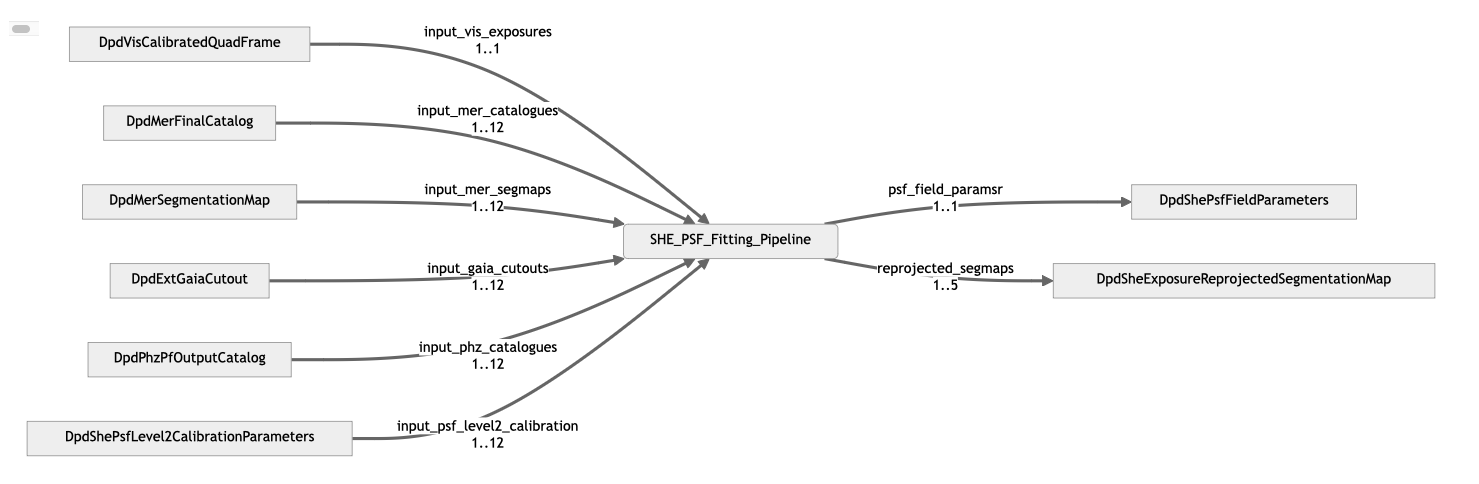
The outputs of these pipelines are multiple DpdShePsfLevel1CalibrationProducts at a variety of solar aspect angles and roll angles and these a basis set of Zernike amplitudes and mean detector dependent effects are used to form a DpdShePsfLevel2CalibrationProduct which will used as the starting point for all the field focus fits in the PSF Fitting pipeline
The shear measurement can be done using the LensMc pipeline, the MomentsML pipeline and/or the MetaCal pipeline. Below is the layout of the lensMc pipeline. The other pipelines will use similar inputs.
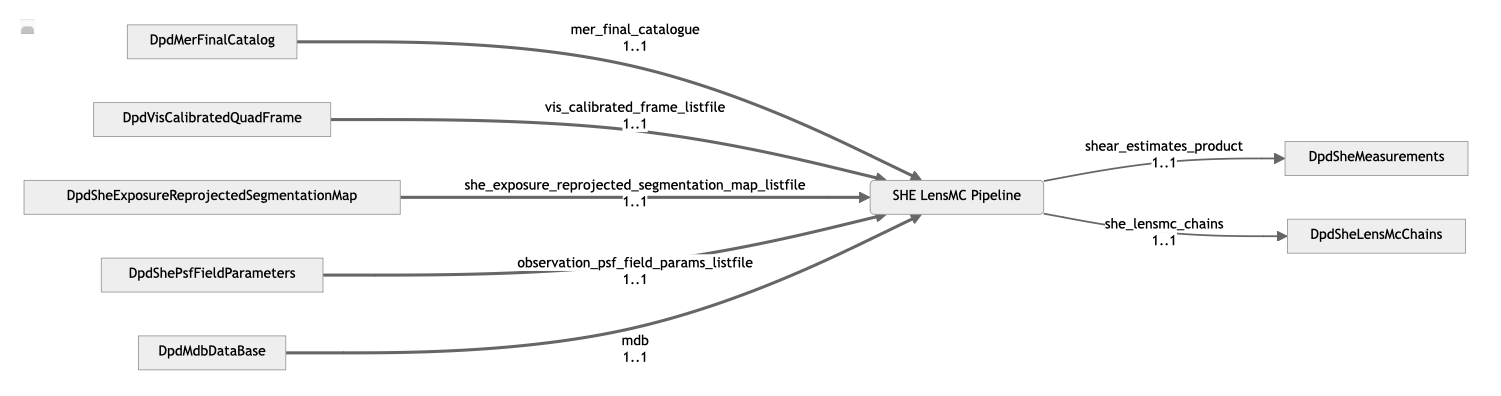
The DpdShearMeasurements product includes measurements from one or more of these methods.

In principle, any shear estimation method can be calibrated to meet Euclid Requirements, provided that it sufficiently captures and adequately encodes the shear information contained in the data for each galaxy. However, in practise not all methods can be calibrated with available calibration data. As different methods have different sensitivities to shear, the calibration data requirements will differ and in some cases may exceed what can reasonably be provided. In addition, as different methods will have different sensitivities to input parameters, they again can require too high an accuracy on measurement parameters. Hence, OU-SHE needs to know the calibrateability of a shear estimation method.

The ShearCalibrateMeasurementsPipeline converts raw measurement catalogs to final measurement catalogs and SHEFinalMeasurements is the output product from SHE that is used by LE3.
OU-SHE inputs the data from other OUs. In particular, stellar images selected by MER in its star-galaxy separation are ingested into SHE and used to measure the SHE PSF. Cuts are made to the stellar catalogue to optimise the PSF measurement or as part of the validation procedure. Galaxy images are ingested into the shear measurement process, which makes use of the SHE PSF to correct optical distortions.
The shear and PSF catalogues generated by SHE are used to carry out the SHE validation. Initially each Euclid field is checked and validated to ensure the local data quality is acceptable. If the field passes this local validation, the catalogue statistics of each field are collected in a master catalogue to be used to characterise the WL qzuality of the survey. Successful fields will be placed in the EAS and will be used by SHE to make global tests of the WL survey, which will pass or fail.
Fields which fail the validation will be flagged, and if the validation identifies a specific problem, this information will be sent to the relevant OU. This process should be as automated as possible.